An existing fiber route can look ready for an upgrade on paper. Records show available strands, equipment plans are complete, and the installation window is approaching. Then field checks uncover inconsistent labels, an undocumented splice, or uncertainty about optical performance. The project now faces two questions: What infrastructure actually exists, and can it support the planned service?
Fiber audits and fiber characterization answer those questions from different angles. An audit investigates the network’s assets, connectivity, and records. Characterization measures the optical properties of selected fiber links.
Both can include testing. The difference lies in the purpose, scope, and deliverables. Understanding that distinction helps telecom teams avoid incomplete assessments, unnecessary work, and surprises during construction or activation.
What is the difference between fiber audits and fiber characterization?
A fiber audit establishes a reliable picture of the network. Fiber characterization establishes measured evidence of optical performance. Neither automatically replaces the other.
Fiber audits verify infrastructure and documentation
Networks change over time. Emergency repairs add splices. Expansion projects change strand assignments. Field crews replace equipment, but the supporting records do not always keep pace.
An audit helps reconcile those changes. Depending on the scope, teams may:
- Identify fiber paths and termination points.
- Verify strand assignments and splice records.
- Inspect accessible network components.
- Investigate discrepancies between field conditions and documentation.
- Perform optical testing to support the investigation.
Celerity’s Fiber Audits service includes documenting fiber paths through physical inspection, testing, and investigation. Its published scope also describes endpoint-to-endpoint optical testing, splice-case investigation where needed, and detailed splice documentation.
The outcome is more than an inventory. Reliable records help engineering and maintenance teams understand which fibers connect which locations and where further work may be necessary.
Fiber characterization measures optical properties
Fiber characterization examines how a link carries light. Depending on the application, testing may assess loss, reflections, splice events, chromatic dispersion, and polarization mode dispersion. The results help engineers evaluate a link against defined transmission requirements. A fiber can have accurate labels and complete records yet still fall outside a planned system’s optical limits.
The practical distinction is:
- Audit: Establishes what exists and whether the documentation reflects it.
- Characterization: Measures optical properties relevant to the intended service.
- Combined assessment: Connects verified asset information with traceable performance results.
Because service packages overlap, project teams should specify the work rather than rely on the service name alone.
What does fiber characterization measure?
Different measurements answer different questions. A useful characterization plan selects the methods that match the route and proposed application.
End-to-end loss and localized events
- Insertion loss testing measures the optical power lost across a link, typically using a light source and power meter. Engineers compare the result with the applicable loss budget.
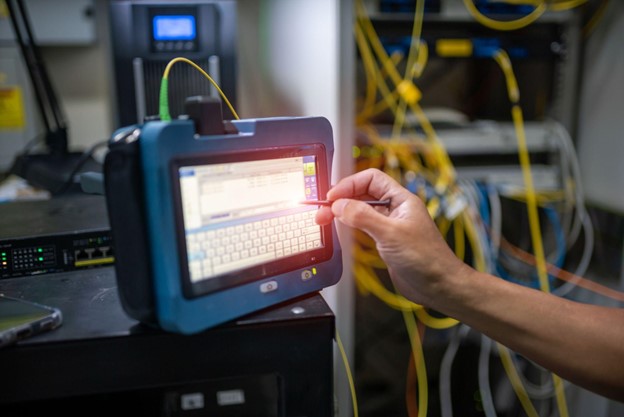
- OTDR testing provides a distance-based view of events along the fiber. An optical time-domain reflectometer can help locate splices, connectors, breaks, and unusual loss.
These methods complement each other. The Fiber Optic Association’s OTDR reference explains that OTDR measurements work indirectly through backscatter, while a source and power meter measure link loss directly.
An OTDR trace therefore should not automatically substitute for end-to-end insertion loss testing. Instrument settings, launch and receive fibers, test direction, and interpretation all affect the usefulness of the results.
Reflections and dispersion
- Optical return loss describes reflected light returning toward the source. Testing can help identify reflection-related concerns that require closer investigation.
- Chromatic dispersion describes differences in travel time among wavelengths.
- Polarization mode dispersion describes differences in travel time associated with polarization modes.
Their importance depends on the fiber route and transmission system. Teams should select dispersion tests based on equipment requirements, link characteristics, and acceptance criteria, not data rate alone.
ITU-T Recommendation G.650.3 addresses test methods for installed single-mode optical fiber cable links. It provides a technical reference, but project specifications still need clear test methods and acceptance limits.
When do telecom teams need both?
Both services offer value when uncertainty affects the asset records and the link’s optical suitability.
Before a capacity upgrade
Available strands do not necessarily equal usable capacity. An audit helps confirm fiber identity, endpoints, and connectivity. Characterization then helps engineers assess the selected path against the proposed system’s requirements. Completing this work before equipment installation can reveal issues while the team still has time to adjust the plan.
During acquisition or dark fiber acceptance
An acquired network may contain inconsistent naming conventions or incomplete repair records. A dark fiber handover may also require verification of connectivity and optical condition.
An audit supports asset reconciliation. Characterization supports technical acceptance against agreed criteria. Together, they help distinguish a documentation problem from a performance problem.
After recurring faults or significant repairs
Maintenance teams need reliable path information to interpret test results. Incorrect labels can send crews toward the wrong strand, while incomplete splice records can complicate fault location.
After a repair, updated documentation captures the changed configuration. Appropriate retesting establishes the condition of the repaired path. Not every project needs both services. A well-documented route with a localized fault may need targeted testing. A records cleanup may not require extensive dispersion measurements. The scope should address the remaining uncertainty.
How should teams plan a coordinated assessment?
The assessment should start with the decision it must support: accepting construction, approving an upgrade, resolving faults, or improving maintenance records.
Before fieldwork, teams should define:
- Assets and boundaries: Routes, endpoints, strands, ownership limits, and accessible facilities.
- Documentation requirements: Drawings, splice sheets, panel assignments, and records needing verification.
- Testing requirements: Methods, wavelengths, directions, and application-specific acceptance limits.
- Operating constraints: Live services, access permissions, maintenance windows, and safe testing procedures.
- Deliverables: Corrected records, native test files, readable reports, exceptions, and retest results.
Every measurement should connect to an identifiable fiber and path. A folder of traces with unclear filenames creates another documentation problem rather than solving one.
Celerity’s fiber optic splicing and testing services include OTDR testing, light source and power meter testing, and fiber optic characterization. Coordinating audit and testing requirements helps teams define a useful engagement.
The business value comes from reducing avoidable uncertainty. Teams can track repeat truck rolls, documentation rework, acceptance delays, and time spent identifying network paths. Those measures reveal whether the assessment improves operations.
Better Records And Better Performance Evidence
Fiber audits and fiber characterization serve different but connected purposes. One strengthens confidence in network information. The other measures optical performance against defined needs. Together, they support better-informed construction, maintenance, and upgrade decisions.
Telecom teams can reach out to Celerity to discuss fiber audits, characterization requirements, and a coordinated assessment for their network.
—-
FAQs
Is a fiber audit the same as fiber characterization?
- No. An audit generally investigates assets, connectivity, condition, and documentation. Characterization measures optical properties. An audit may include optical testing, so the statement of work should define the measurements and deliverables included.
Is OTDR testing enough to characterize a fiber link?
- Not always. OTDR testing helps locate and assess events, but a project may also require end-to-end loss, return loss, or dispersion measurements. The intended application and acceptance criteria determine the appropriate test package.
Does every upgrade require chromatic dispersion and PMD testing?
- No single test package fits every upgrade. Engineers should consider route length, fiber characteristics, transmission equipment, and contractual requirements when deciding whether chromatic dispersion and polarization mode dispersion testing are necessary.
What can Celerity’s fiber audits include?
- Celerity describes fiber-path documentation, physical inspection, optical testing between termination points, splice-case investigation where needed, and verification of splice assignments. The agreed project scope determines which activities and documentation deliverables apply.
Does Celerity also offer fiber characterization?
- Yes. Celerity lists fiber optic characterization alongside OTDR and light source and power meter testing. Its broader testing services describe optical return loss, chromatic dispersion, and polarization mode dispersion testing. Teams should confirm the required test scope directly with Celerity.