The NESC is the safety standard for electric supply and communications lines. IEEE publishes it exclusively and updates it every five years. The current edition is the 2023 NESC. According to IEEE's NESC overview, the American National Standards Institute approves each edition, and the code has been in continuous use since the first edition in 1915.
The NESC is a safety code, not a design manual. It does not give step-by-step instructions. It sets ground rules for safe clearances, grounding, pole loading, and work practices, and it treats hazard avoidance as the main goal.
Many people confuse it with the National Electrical Code, which governs wiring inside buildings. The NESC covers the utility side of the service point. IEEE notes that the NESC is a voluntary standard. Even so, state legislatures and public utility commissions typically adopt it into law, and it applies to cooperatives financed by the USDA Rural Utilities Service. IEEE also reports that more than 100 countries use it as an authoritative reference.
Anatomy of the Communications Space
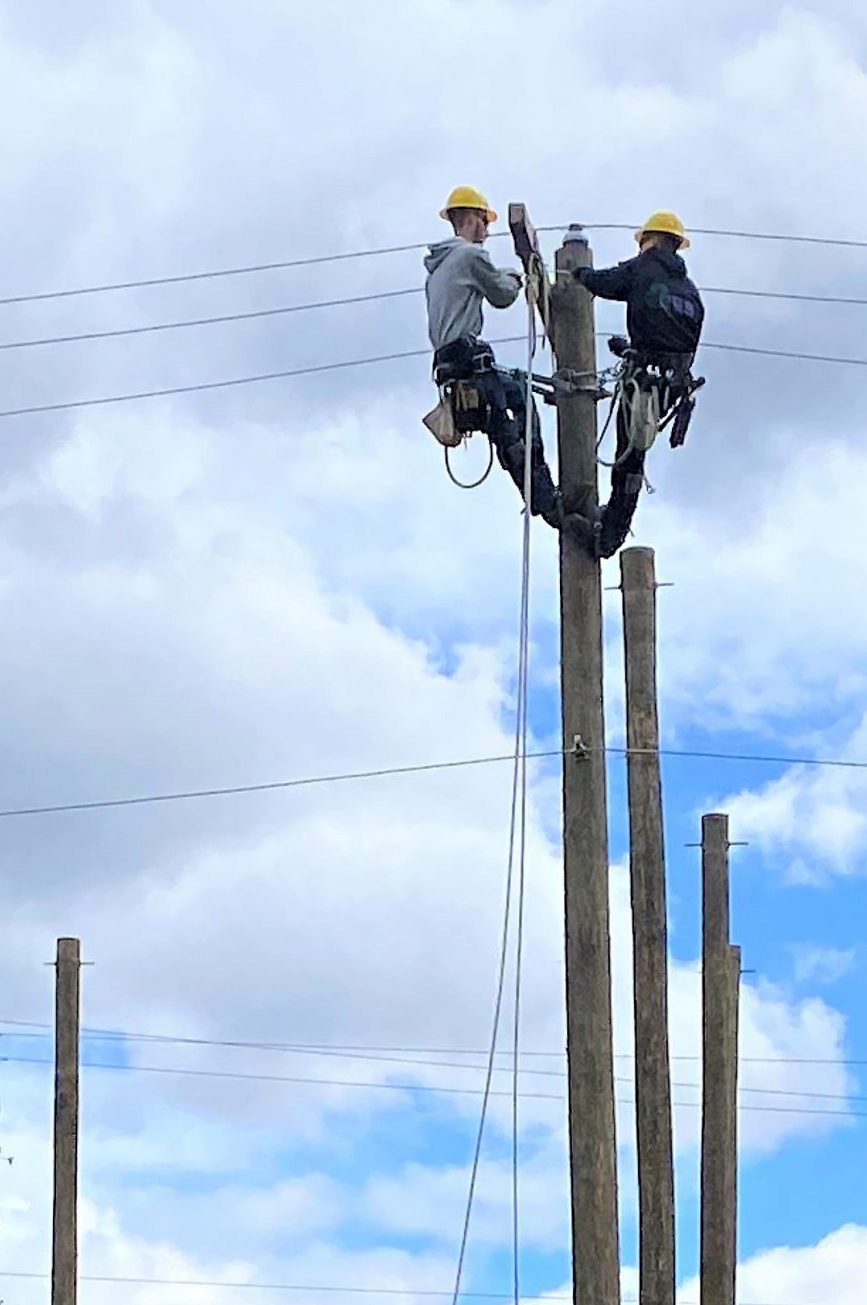
Think of a utility pole as an apartment building. Power lines live on the top floors. Communications lines live lower down. A safety gap sits between them, and workers depend on that gap.
From top to bottom, a typical pole holds these layers:
- Supply space: High-voltage power conductors and equipment sit at the top.
- Safety space: This buffer separates power from communications. Utilities commonly work with a 40-inch separation here under NESC clearance rules. The exact requirement depends on the situation, so crews confirm it against the current code edition and the pole owner's standards.
- Communications space: Cable TV, telephone, and fiber attachments sit in this lower zone. A new fiber line usually goes here.
Why the Space Between Wires Matters
Communications workers do not train to work near energized power conductors. The NESC keeps the two groups apart so each can work safely. That is why pole work is rarely "just hang a cable." A new attachment can force other companies to move their lines up or down to restore proper clearances. That adjustment work has a name: make-ready.
Why Make-Ready Slows Down Fiber Builds
Make-ready is the work that prepares a pole for a new attachment. It can mean moving existing wires, replacing a pole, or correcting old violations. Under the traditional process, each company with equipment on the pole sends its own crew to move its own lines. One pole can need several separate visits. That creates delay. Every visit needs scheduling, notices, and coordination. One company's crew waits on another's. Across thousands of poles, the waiting adds up fast.
The FCC sets timelines to limit that delay. Under the standard process in 47 CFR 1.1411, the key deadlines look like this:
- Application review and survey: A utility has 45 days after it receives a complete application. Mid-sized orders get 60 days, and large orders get 90.
- Communications space make-ready: Work must finish within 30 days of notice. Mid-sized orders get up to 75 days, and large orders get up to 120.
- Make-ready above the communications space: Work can take up to 90 days after notice, with longer periods for larger orders.
In Celerity's field work on aerial fiber projects, the biggest schedule risk usually comes from coordination, not construction. A crew can often finish a pole in hours. Getting every party to the same pole at the right time can take weeks.
How One-Touch Make-Ready Changes the Process
One-Touch Make-Ready, often shortened to OTMR, targets that coordination problem. Instead of many crews making many trips, one qualified contractor completes all the simple work in a single visit.
The FCC rule lets a new attacher choose this option for simple make-ready. The process runs in six steps:
- Election in the application. The new attacher chooses OTMR in writing and identifies the simple make-ready it plans to perform.
- Faster utility review. The utility has 15 days to grant or deny a complete application. Mid-sized orders get 30 days, and large orders get 45.
- Attacher-run surveys. The new attacher handles the surveys with a qualified contractor. The utility and existing attachers may attend.
- Advance notice. The attacher gives 15 days of written notice before work begins.
- Stop rule. If crews find that the work is complex, they halt that make-ready and move it to the standard process.
- Post-work inspection. The attacher reports completion within 15 days. Utilities and existing attachers then have 90 days to inspect and 14 more days to report damage or code violations.
The rule also protects the pole owner. A utility can object in writing, with evidence, if it believes the work is not simple. That objection is final when the utility makes it in good faith. The rule also makes the new attacher responsible for any damage its crew causes.
Why the NESC Matters Even More Under OTMR
OTMR puts more responsibility on the contractor. The engineering firm or contractor has to decide whether a job is truly simple. It also has to know how NESC clearances, loading, and grounding apply to every pole. A wrong call can create a safety hazard, a code violation, and rework at the attacher's expense.
Contractor choice therefore matters. A crew that knows the NESC can spot a complex pole before work begins. It can also document the work so utilities can inspect it quickly.
Celerity provides engineering, aerial and underground construction, splicing, testing, and maintenance. One team can carry a project from design through closeout, which keeps the engineering assumptions and the field work aligned.
What This Means for the Next Fiber Project
Three habits help projects move faster:
- Plan routes with the communications space in mind. Early design choices decide how much make-ready a route needs.
- Run pole loading and clearance checks before applying. Clean applications clear the completeness review sooner.
- Choose OTMR when the work qualifies as simple. Fewer visits mean fewer delays.
The result is fewer truck rolls, fewer handoffs, and a clearer path to a live network. Rules also change. The FCC amended these pole attachment rules in 2025, so project teams should confirm current requirements before every build.
Plan Your Pole Attachment Project With Celerity
Successful fiber construction starts with careful planning, a clear understanding of regulatory requirements and the experience to navigate challenges in the field. From pole attachment applications and make-ready work to construction coordination and project timelines, every step requires attention to detail to keep projects moving forward.
Celerity's experienced team understands the National Electrical Safety Code (NESC), FCC pole attachment timelines and the day-to-day realities of communications infrastructure projects. The team helps clients navigate complex requirements, identify potential obstacles early and coordinate the work needed to support efficient, compliant fiber deployment.
Whether you're planning a new aerial fiber network, expanding existing infrastructure or preparing for make-ready construction, Celerity brings the technical knowledge and hands-on experience to help move your project from planning to execution. Contact Celerity to discuss the next aerial fiber or make-ready project.
—--
FAQs
What is the National Electrical Safety Code?
- The National Electrical Safety Code is the IEEE safety standard for electric supply and communications lines. It covers clearances, grounding, loading, and work practices for utility systems. Utilities, contractors, and regulators use it, and many states adopt it into law.
What is the communications space on a utility pole?
- The communications space is the section of the pole below the power lines. Cable, telephone, and fiber attachments sit there. A safety space separates it from the power conductors so communications workers stay clear of energized equipment.
What is make-ready work?
- Make-ready is the work that prepares a pole for a new attachment. It can include moving existing lines, adjusting clearances, correcting violations, or replacing the pole.
What is one-touch make-ready?
- One-touch make-ready lets one qualified contractor perform all simple make-ready work in a single visit. It replaces the traditional process, where each attacher sends its own crew.
Who decides whether make-ready is simple?
- The Engineering Firm tasked with Make Ready Engineering or the contractor, makes the first call. The utility can object in writing with supporting evidence. If it does, the work becomes complex and follows the standard timeline.
Does the NESC apply to fiber attachments?
- Yes. The NESC covers overhead communications lines, so it applies to fiber on utility poles. Clearances, loading, and grounding rules all affect where and how crews attach new cable.