Across enterprise data centers, telecommunications providers, and network infrastructure companies, the demand for greater bandwidth is accelerating faster than ever. Even networks upgraded just a few years ago are now straining under the explosive growth of artificial intelligence workloads, machine learning applications, and cloud-based services. As organizations move from 100G to 400G and soon to 800G, the shift represents far more than a hardware upgrade and actually involves more of a complete evolution in how networks are tested, validated, and maintained.
The global 800G Ethernet market, which reached $2.7 billion in 2024, underscores this transformation. Preparing for next-generation network speeds requires not only the right equipment but also a strategic approach to testing methodologies, performance verification, and long-term scalability. This article explores how organizations can prepare their infrastructure and teams for the next wave of high-capacity network performance.
Why 400G and 800G Testing Demands a Different Approach
Traditional fiber testing methods that worked perfectly for 10G and even 100G networks often fall short when validating 400G and 800G systems. The reason lies in the underlying technology shift. These higher speeds rely on PAM4 (Pulse Amplitude Modulation 4-level) signaling rather than the simpler NRZ (Non-Return-to-Zero) encoding used in legacy systems. PAM4 transmits two bits per symbol instead of one, effectively doubling data rates without requiring proportionally higher bandwidth. However, PAM4 signals are inherently more sensitive to noise, dispersion, and signal degradation.
In our work with clients upgrading their network infrastructure, we consistently see organizations underestimate the testing complexity. A fiber link that passes basic insertion loss testing may still fail catastrophically under actual 400G or 800G traffic loads. The signal-to-noise ratio requirements become exponentially more stringent. According to EXFO's testing guidelines, even minor connector contamination or fiber bending that would barely register on 100G systems can cause unacceptable bit error rates at 400G speeds.
Network downtime in a modern data center can cost enterprises between $5,000 and $9,000 per minute, according to industry analysts. When data centers factor in the reputational damage and potential SLA violations, the true cost of inadequate testing increases. Organizations cannot afford to discover compatibility issues after deployment.
Essential Testing Equipment for Next-Generation Networks
Preparing for 400G and 800G upgrades requires organizations to invest in the right testing tools before initiating the transition. The testing equipment landscape has advanced significantly, and relying on outdated test sets can leave critical network vulnerabilities undetected.
First, organizations need an optical time domain reflectometer (OTDR) capable of characterizing fiber at the wavelengths used by their new transceivers. Modern 400G systems typically operate at 1310nm for shorter reaches and 1550nm for longer distances. The OTDR testing equipment must provide accurate loss measurements, identify splice points, detect micro-bends, and locate any reflective events that could degrade signal quality. The device should offer bidirectional testing capabilities, as issues may appear differently depending on the direction of light propagation.
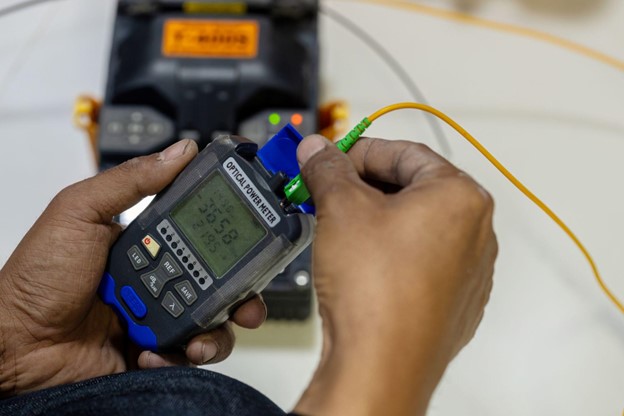
Power meters and light sources form the second critical component. These tools verify that the fiber infrastructure can deliver adequate optical power to the receiving equipment. For 400G and 800G systems, organizations require instruments capable of measuring across multiple wavelengths simultaneously, as these networks often rely on wavelength division multiplexing to achieve higher speeds. Single-wavelength testing is insufficient and can overlook critical issues in CWDM and DWDM deployments.
Fiber inspection microscopes have become non-negotiable for high-speed networks. These devices capture high-resolution images of connector end faces, automatically detecting scratches, contamination, and geometric defects that human inspectors might miss.
For organizations deploying coherent optics in their 400G and 800G infrastructure, optical spectrum analyzers become essential. These instruments visualize the optical spectrum, allowing technicians to verify channel spacing in DWDM systems, measure optical signal-to-noise ratios, and identify unwanted spectral components that could cause crosstalk. Integrated test platforms can combine multiple functions into portable units suitable for field deployment.
Finally, high-speed Ethernet testers that support native 400G and 800G interfaces validate real network performance under realistic traffic conditions. These instruments generate test patterns, measure throughput, verify forward error correction functionality, and stress-test the infrastructure before production traffic is introduced. It is essential to select testers that support electrical and optical interfaces, as performance must be validated at multiple points within the network architecture.
The Five-Step Testing Methodology for High-Speed Upgrades
Successfully transitioning to 400G and 800G requires a systematic approach that catches problems early when they are still inexpensive to fix. Based on industry best practices and lessons learned, this five-step methodology provides a proven framework.
Step One
- A comprehensive fiber characterization analysis should be performed before any equipment upgrades occur. Document existing infrastructure thoroughly, running OTDR tests on every fiber strand planned to be used for high-speed services. Measure insertion loss, return loss, and optical length. Many organizations skip this step and later regret it when they cannot determine whether problems stem from new equipment or pre-existing fiber issues.
Step Two
- Focus on cleaning and inspection. Every connector, every adapter, every patch panel must be inspected and cleaned according to manufacturer specifications. This process prevents the majority of field failures. Automated inspection tools speed this process considerably while maintaining quality standards.
Step Three
- Introduce compatibility testing in a controlled lab environment before field deployment. Install new 400G or 800G transceivers in a test setup that mimics the production environment. Verify that optics from different vendors can interoperate successfully, as even standards-compliant components sometimes exhibit incompatibilities. Run extended burn-in tests to identify infant mortality failures before they impact the network.
Step Four
- Rather than upgrading the entire network simultaneously, identify a non-critical segment for initial deployment. Install 400G or 800G equipment, bring it online, and monitor performance metrics obsessively for at least two weeks. Track bit error rates, optical power levels, temperature readings, and any forward error correction statistics. This approach allows the refinement of procedures and catch unexpected issues before they affect mission-critical services.
Step Five
- High-speed networks require more frequent inspection and testing than their slower predecessors. Implement quarterly fiber inspections, semi-annual OTDR testing, and continuous performance monitoring through the network management system. Create runbooks that document exactly how to respond when specific alarms trigger. Train technical staff on the unique characteristics of PAM4 signaling and the troubleshooting techniques that apply to 400G and 800G systems.
Future-Proofing Your Network Infrastructure
Future-proofing requires making smart choices now that will pay dividends for years to come. Cable plant design represents the most important future-proofing decision. While multimode fiber works adequately for short-reach 400G connections within a single data center, single-mode fiber provides the flexibility to support longer distances and future speed increases. Industry experts recommend deploying OM5 multimode fiber at minimum for new installations, though single-mode fiber offers superior longevity. The incremental cost difference is minimal compared to the expense of re-cabling later.
Connector technology matters more than many organizations realize. Traditional LC duplex connectors served the industry well for decades, but higher-speed networks increasingly rely on MPO/MTP connectors that support multiple fibers in a single interface. A 400G QSFP-DD transceiver using 400GBASE-SR8 requires eight fiber pairs, making MPO connectivity almost mandatory.
Testing equipment should be modular and software-upgradeable whenever possible. The test set purchased today should support firmware updates that add new capabilities as standards evolve. Leading vendors design their platforms with this principle in mind, allowing customers to add 800G testing modules to existing chassis rather than replacing entire systems.
Finally, documentation and data management deserve special attention in the context of future-proofing. Every test result, every fiber characterization, every inspection image should be stored in a centralized database accessible to the entire technical team. Cloud-based platforms enable real-time collaboration, allowing field technicians to share results instantly with network engineers and managers. This data becomes invaluable when planning future upgrades or troubleshooting mysterious performance issues.
The transition to 400G and 800G networks represents both a challenge and an opportunity. Organizations that approach these upgrades methodically, invest in proper fiber optic testing equipment, and follow proven methodologies will position themselves to capitalize on the performance benefits while avoiding costly mistakes. The future of networking is faster, denser, and more complex, but with the right preparation, the infrastructure can meet whatever demands tomorrow brings.